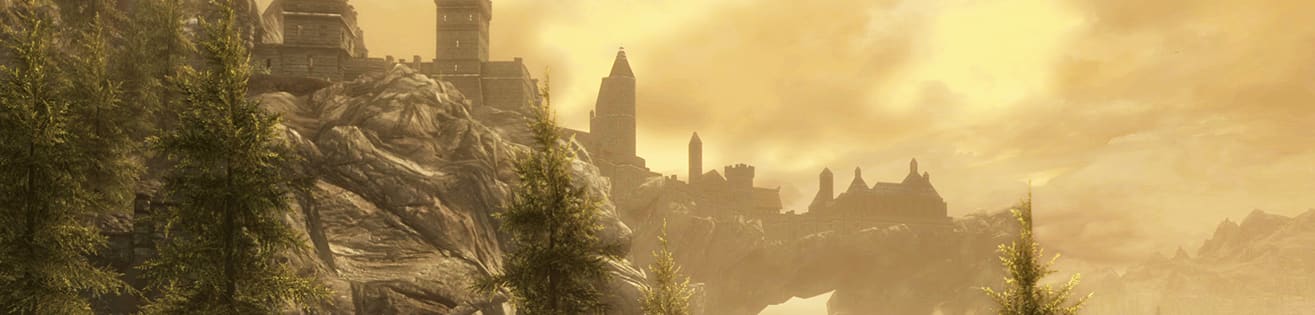
What Makes The Elder Scrolls V: Skyrim Special

There’s a pretty good chance you’ve heard of The Elder Scrolls V: Skyrim.
The award-winning release is beloved by millions, hailed by critics and enthusiastically embraced by an active community to this day. And later this year, it hits Xbox One, PlayStation 4 and PC in an updated form. The Elder Scrolls V: Skyrim Special Edition features fully remastered graphics, along with all three official add-ons packed-in: Dawnguard, Hearthfire and Dragonborn.
It’s kind of a big deal. But in order to understand why it’s such a big deal, we need to take a look at where Skyrim came from.
If you’ve already played Skyrim, be sure to share your experiences with us on Twitter, Facebook and Instagram, using the hashtag #SkyrimMemories. We’ll share our favorites, and we’ll also bring one of your memories to life in a special animated feature!
The Eldest Scrolls
The year was 1994. Nancy Kerrigan, Tonya Harding and O.J. Simpson were all over the news. Major League Baseball players were on strike. Justin Bieber was born. Kurt Cobain died. And an unassuming developer named Bethesda Softworks was about to make gaming history.
When The Elder Scrolls: Arena arrived on the scene, reviewers weren’t quite sure what to make of it. The world of role-playing games had been trending in an action-oriented direction, frustrating fans of older, more deliberate RPGs. And here comes a game that, on its surface, appears as action-oriented as any other, with a deep real-time combat system – and yet, it is positively packed with content, boasting a ridiculously large world hosting more than 60 major cities, with no artificial limitations on where the player could travel.
Fans went crazy for Arena, turning the game into a bona-fide cult hit. Just two years later, those fans went even crazier for The Elder Scrolls II: Daggerfall. Deeper combat, a richer story and a vast array of enemies characterized Daggerfall, but its most impressive claim to fame was its astounding size – roughly as big as Great Britain. Next came The Elder Scrolls III: Morrowind, which offered a more crafted experience (albeit in a smaller world). The game earned near-universal praise for its astonishing mix of size and detail, and its balance of rich story with open-ended player freedom.
But these three releases were just the first boulders preceding an avalanche. In the midst of a perfect storm of technological advances and a boom in the gaming population, 2006 brought the release of The Elder Scrolls IV: Oblivion.
To call Oblivion “well-liked” is a dramatic understatement. The game was met with such widespread critical acclaim that it became a near-instant sensation. By the end of the year Oblivion had become the studio’s first consensus Game of the Year title, quickly making it onto many critics’ Best of All Time lists thanks to its dimension-spanning, world-saving story, gorgeous environments and glorious player freedom.
In other words, Oblivion was essentially the definition of a tough act to follow.
Dragonborn at the Right Time
By 2011, pretty much everyone in the gaming world knew about The Elder Scrolls. Expectations were sky-high for the follow-up to Oblivion, with millions of new fans eagerly awaiting the next chapter. It was hard to imagine how The Elder Scrolls V: Skyrim could manage to deliver on those expectations.
But deliver it did, and then some. First was the story: Where previous Elder Scrolls games had put the player in a role assisting great and powerful characters, in Skyrim you are the great and powerful – the last Dovahkiin, a prophesized hero born with the body of a mortal and the soul of a dragon, whose destiny it is to save the Empire. In the course of developing those powers, you hunt dragons, halt a civil war, revive an ancient order or two, and visit the afterlife itself. (And that’s just in the main quest line.) The epic story sends players ranging through the entire region, and yet still manages to feel personal and powerful.
And then there’s the game world itself. Forsaking the idyllic forests, pastures and coastlines of Oblivion’s Cyrodiil, Skyrim is set in the forbidding northern province after which it’s named, pierced by pitiless mountain peaks and crowned with ice and snow. And yet, in spite of the harsh surroundings, the game is loaded with visual variety, from isolated pockets of greenery; to stark, crumbling ruins; to the vast, subterranean beauty of Blackreach. While technically smaller than Cyrodiil (and, of course, dramatically smaller than Daggerfall), Skyrim is so densely packed with things to discover that it feels significantly larger.
Better still, this world is populated by characters and creatures all doing their own thing, living their lives, working toward their own ends. Wolves hunt deer; giants herd mammoths; dragons attack settlements; vampires ambush bandits. You can choose to participate in these encounters or ignore them completely, but they never fail to give the sense of a living, breathing world, a sense that events are unfolding whether you’re there to witness them or not.
Of course, should you choose to engage in these activities, you’ll discover a combat system evolved from Oblivion’s. Thanks to the ability to wield two completely different items at once (assuming they’re not two-handed weapons, naturally), combat is much more varied and organic. You can hold a deadly blade in one hand and an equally deadly fireball spell in the other, switching between different loadouts as the situation demands. And no matter what you’re holding, you also have the power of your voice. The Shouts you can belt out as a Dragonborn add a third method of attack or defense.
For those of a more pacifistic bent, Skyrim also raised the bar when it comes to crafting. Rather than just repairing items, you can now learn to craft your own armor, weapons, jewelry, potions – even food – from the rawest of raw materials. Many an afternoon has been spent ignoring the problems of Tamriel just to complete a set of Dragonbone armor.
And this is all just the base game. Three expansions added new types of gameplay alongside new rosters of items, characters and quests. Dawnguard brought two new factions to the world, as well as the ability to transform into a Vampire Lord. Hearthfire introduced the ability to build and customize your own home. And Dragonborn brought the ability to tame – and ride! – your own dragon. (As mentioned, all of Skyrim’s expansions will be included in the Special Edition; in fact, if you’ve purchased all of them on Steam, you get the Special Edition free.)
Beyond the Sea of Ghosts
And how was this all received? First came the reviews, which topped even Oblivion’s in nearly every outlet. Next came the awards: It won more than 200 Game of the Year awards, and has been called the greatest game of all time by several publications. And then came the sales: In a 2014 press release, Bethesda casually mentioned that Skyrim had sold over 20 million copies… and that was two years ago!
The continued interest in Skyrim has helped it transcend the videogame industry, entering the wider world of pop culture in a variety of ways. The game has been referenced in shows like South Park, Futurama and NCIS; it made an appearance in the early days of Conan O’Brien’s Clueless Gamer; its theme has been covered dozens of times by musicians worldwide; and of course “Fus Ro Dah” and “taking an arrow to the knee” have taken on lives of their own as internet memes. (Not to mention earning nods from other games as diverse as World of Warcraft, League of Legends and Borderlands 2.)

We’re sorry but you may not access this content. Please review our Privacy Policy
So yes, Skyrim is still a big deal. That’s why, five years after its initial release, it’s coming back. Console players will be able to enjoy this vast adventure on the latest systems, and everyone (including PC gamers) will get the benefit of the remastered graphics and robust add-ons. (PC gamers also get to experience Skyrim in 64-bit.) For some, Skyrim Special Edition will be their first trip into this epic world. For others, it will be a return to familiar territory. But no matter whether you’re a newbie or a seasoned vet, no two experiences will be the same. That’s part of what makes Elder Scrolls games so compelling. And it’s a large part of why, half a decade later, Skyrim still matters.


